
Best Tech Stack for Web App Development in 2026
Choosing the best tech stack for a web app means matching tools to your product, team, and growth plans. A good stack lets you launch quickly, keeps maintenance reasonable, and does not force a costly rewrite as traffic grows.
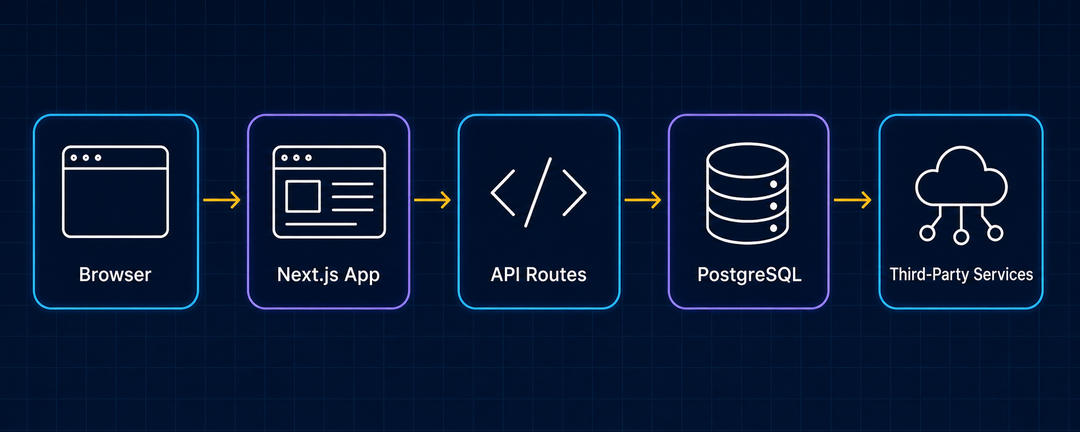
For most modern products, the best web tech stack in 2026 is Next.js, TypeScript, PostgreSQL, and a managed cloud platform. It is a strong default for SaaS products, marketplaces, dashboards, AI-enabled tools, and content-heavy sites.

The recommended web app stack
Here is a practical, production-ready combination:
| Layer | Recommended technology | Why it works |
|---|---|---|
| Frontend | Next.js + React + TypeScript | Fast pages, SEO support, and a mature component ecosystem |
| Styling | Tailwind CSS | Rapid, consistent UI development |
| Backend | Next.js Route Handlers or Node.js | Keeps the first version simple while remaining flexible |
| Database | PostgreSQL | Reliable relational data, great tooling, and room to grow |
| ORM | Prisma or Drizzle | Safer database queries and easier migrations |
| Authentication | Auth.js, Clerk, or Supabase Auth | Avoids building sensitive auth flows from scratch |
| Hosting | Vercel, AWS, or Cloudflare | Easy deployment, scaling, and global performance |
| Monitoring | Sentry + product analytics | Helps find errors and understand user behavior |
Why Next.js is a smart default
Next.js combines a React user interface with server-side rendering, API capabilities, routing, image optimization, and strong SEO foundations. Your marketing pages can rank in search while your authenticated app stays responsive.
TypeScript catches common mistakes before they reach users. Tailwind CSS speeds design work, while PostgreSQL gives your data model a stable foundation for an MVP or growing application.
Best tech stack for a startup MVP
The best tech stack for a startup should optimize for learning, not theoretical perfection. Start with Next.js, TypeScript, PostgreSQL, a managed database such as Supabase or Neon, and Vercel hosting. Add payments, email, analytics, and AI APIs only when the product needs them.
Avoid microservices at the beginning. A modular monolith—a single application with clear feature boundaries—is faster to build, easier to deploy, and simpler to debug. Split services later when usage, team size, or reliability requirements prove the need.
How to choose your stack
Before committing, ask:
- Does your team already know React and JavaScript?
- Are speed to market and low operational overhead more important than custom infrastructure?
If the answers are mostly yes, this stack is an excellent fit. Use TechStackChecker to explore the technologies behind successful websites, compare implementation patterns, and make a more informed decision before you build.
If you want a team to implement this stack for you — an SEO-friendly website, a custom admin panel, or an MVP — Hexanova builds production web products for businesses and startups.
The best tech stack for web app development is ultimately the one your team can ship, secure, monitor, and evolve confidently. For most teams in 2026, Next.js, TypeScript, PostgreSQL, and managed cloud services provide that balance.